
Our news & events
Share

Enalees launches new Rhéa® respiratory panel: a new clinical reference for LAMP PCR diagnosis of respiratory diseases in livestock

Enalees, a French company pioneering molecular veterinary diagnostics, announces the launch of its new respiratory panel, expanding the Rhéa® range, designed for cattle, sheep, and goats. Based on LAMP technology (Loop-mediated Isothermal Amplification), this panel can identify in under 30 minutes the main pathogens responsible for respiratory diseases in ruminants: BRSV (Bovine Respiratory Syncytial Virus), Mycoplasma bovis, Pasteurella multocida, and BHV-4 (Bovine Herpesvirus 4).

With this innovation, Enalees offers veterinarians a simple and rapid point-of-care diagnostic solution, designed to improve animal welfare, strengthen herd health management, and optimise the economic efficiency of farms.

Fast and reliable tool, built for the field

Unlike conventional PCR, LAMP technology operates at a constant temperature, significantly reducing analysis time while maintaining comparable sensitivity. The new Rhéa® respiratory panel is used with a portable reader, requiring neither a laboratory nor expensive heavy equipment, and provides actionable results directly in the clinic or on-farm.

The ability to analyse a sample at the animal’s side allows immediate decision-making: biosecurity measures such as isolation, and targeted, personalised treatment.

Laurent Thiery, CEO of Enalees:

« With this new panel in the Rhéa® range, we provide veterinarians with a field-ready solution that can transform the management of respiratory diseases. Results in just 30 minutes, directly in the clinic, become a genuine lever to improve animal welfare, reduce economic losses, and enhance herd health management  »

A major economic challenge: acting early to limit losses

Respiratory diseases are among the leading causes of economic losses in livestock: mortality, slower average daily gain (ADG), reduced milk production, repeated treatments, and prolonged recovery.

By enabling early diagnosis, the Rhéa® respiratory panel helps to:

  • Reduce growth losses (ADG)
  • Lower veterinary costs through more targeted treatments
  • Limit pathogen spread within the herd
  • Reduce antibiotic use when the cause is viral

Strengthening the veterinarian’s role in responsible practice

Immediate results give veterinarians greater accuracy, responsiveness, and advisory capacity. A positive test for a viral agent such as BRSV can prevent unnecessary antibiotic treatment when the animal carries only that pathogen. The Rhéa® Respiratory panel also detects co-infections more broadly, allowing the administration of appropriate treatment. This rational diagnostic approach aligns with national objectives to reduce antimicrobial resistance and supports a modern vision of animal health.

[Focus UK]

Since May 2024, the new UK Veterinary Medicines Regulations prohibit the routine use of antibiotics in livestock and only allow group prophylaxis under very limited circumstances (saveourantibiotics.org). In this post-Brexit context, the UK cattle sector is seeking to maximise productivity with more intensive herds while maintaining strict health standards. The UK estimates losses due to respiratory diseases at around £80 million per year (nadis.org.uk).

Rhéa® supports UK veterinary practices by complementing the RCVS “Test–Treat–Evaluate” approach: veterinarians can perform tests on-farm without waiting for laboratory results. This enhances their role as herd health consultants, ensuring rapid compliance with new regulatory requirements (hygiene, targeted vaccination). The panel fits into UK farm health programmes, helping improve herd competitiveness amid rising costs and commercial pressures (export under “Red Tractor” standards).
About d’Enalees

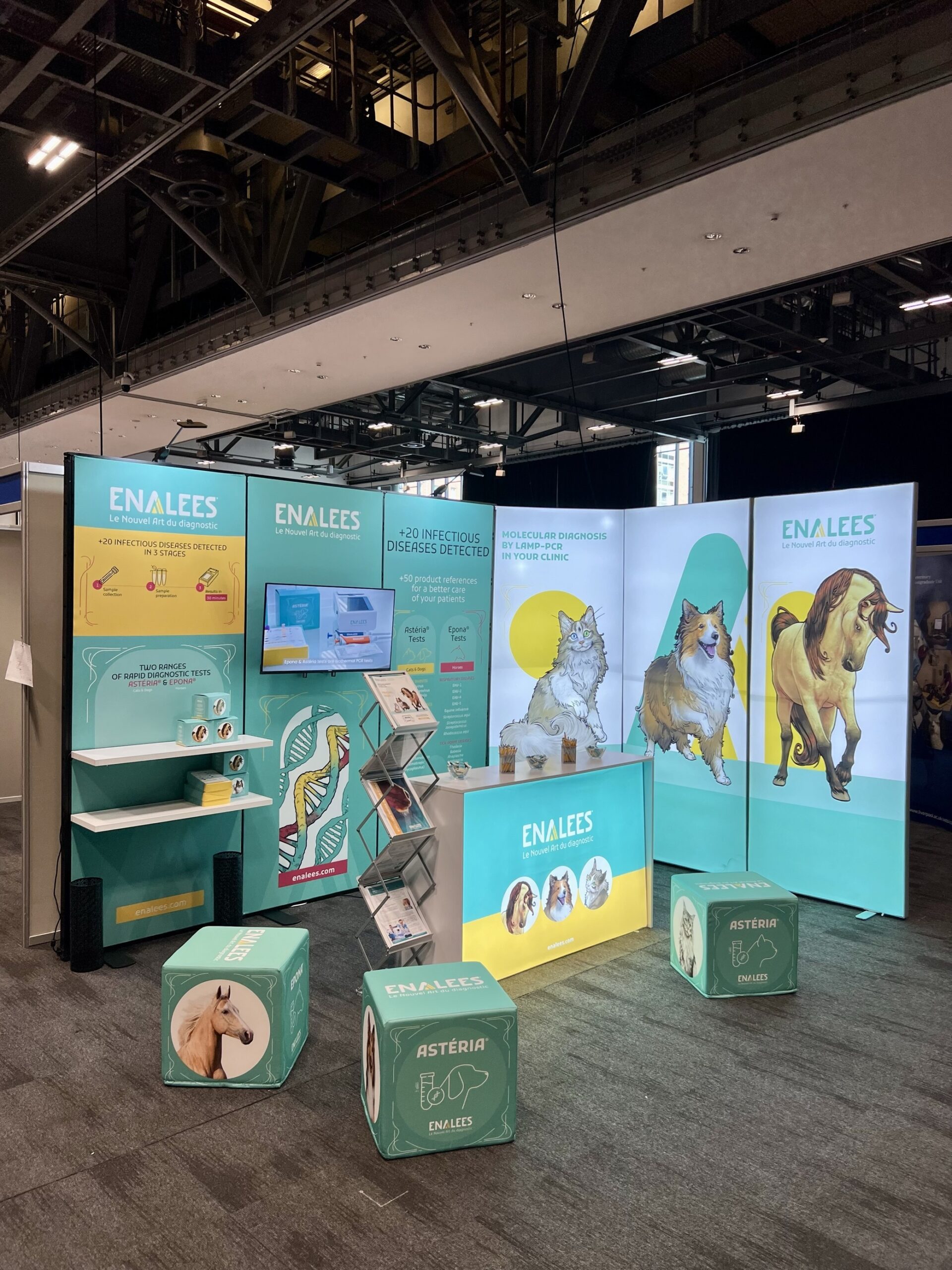
Enalees  develops,  manufactures  and  markets  rapid  isothermal  PCR  tests  that  enable veterinarians to diagnose suspected infectious diseases – either in the clinic or directly in the field – without the need to send samples to a specialized laboratory. Its team, mainly made up of doctors, veterinarians and biology engineers and technicians, develops innovative tests for both pets and livestock.

The tests use LAMP technology. This allows the amplification of the DNA sequence and offers four advantages: specificity and a sensitivity equivalent to PCR, while combining rapid results with robustness.

Enalees offers more than 60 tests via three ranges: Epona® (horses), Astéria® (dogs/cats) and Rhéa®  (ruminants).  These  can  detect  more  than  25  infectious  diseases,  including rhinopneumonitis, flu, borreliosis (the pathogen that causes Lyme disease), even leptospirosis.

The Enalees facilities (R&D and production) have been at the Genopole Biocluster in Essonne, France since 2016. Enalees has a production capacity of one million units per year, serving its own animal health business and its partners, for whom it develops and manufactures custom tests.

Enalees currently has 43 employees globally.

Contact Enalees

Florence Fombertasse
Marketing & Communication CO
florence.fombertasse@enalees.com
+33 (0)749 329 506

Download the press release

SEE PRODUCT


Stay
Informed

Event

London Vet Show • 14-15 November 2024 • London • Stand B45

Throughout the year, Enalees takes part in the main congresses in the UK.Please do not hesitate to contact us to make an appointment or to visit our stand.Follow us on Facebook and LinkedIn for all th...

OPTIMIZING DIAGNOSIS AND FOLLOW-UP OF PARASITIC INFECTIONS IN A MIXED VETERINARY CLINIC
Case Studies

OPTIMIZING DIAGNOSIS AND FOLLOW-UP OF PARASITIC INFECTIONS IN A MIXED VETERINARY CLINIC

The Baume-les-Dames veterinary clinic, co-led by Dr. Tomatis, is a mixed practice treating small animals, horses and exotic animals. Since May–June 2022, the clinic has been using Enalees’ rapid mol...

Highland cow - BRSV - Enalees
Scientific newsletter

BRSV : Anticipating winter waves

Bovine Respiratory Syncytial Virus (BRSV) is a single-stranded virus belonging to the Pneumoviridae family1,2. It was renamed Bovine orthopneumovirus in 2016 and Orthopneumovirus bovis in 20221. It is...

Scientific newsletter

Feline coronavirus

Feline CoronavirusFeline coronaviruses (FCoV) are frequent in feline populations, particularly in community settings. Although the majority of infections are benign, around 5% of infected cats develop...

CASE STUDY: EQUINE INFLUENZA
Case Studies

MANAGING EQUINE INFLUENZA IN A VETERINARY CLINICAL CENTER

Our client suspected an outbreak of equine influenza among its teaching horses. How can it be diagnosed quickly in order to implement reinforced biosecurity measures and prevent its spread to clie...

SUBSCRIBE TO OURNEWSLETTER

Receive our latest news, exclusive offers and expert advice straight to your inbox. Sign up so you don't miss a thing!

Cart
Your cart is empty.